
Stop searching and wasting time.Here is the IT and Tech news you need.
Friday, February 24, 2012
36 state AGs blast Google's privacy policy change
Attorneys General from 36 states are concerned over the potential implications of Google's new privacy policy, especially for government users and owners of Android-powered smartphones.
In a sharply-worded letter (a target="new" href="http://epic.org/privacy/google/20120222-Google-Privacy-Policy-Final.pdf">download PDF) to Google CEO Larry Page, the officials questioned Google's commitment to consumer privacy and said the changes would force Internet users to share their data without giving them a proper ability to opt out.
The letter is the latest, and perhaps most dramatic, expression of concern stemming from Google's announcement that it would create a single privacy policy for all its online products. Under the new policy, scheduled to go into effect March 1, Google will combine user data from services like YouTube, Gmail and Google search and create a single merged profile for each user of its services.

FAQ: What Google's 'Do Not Track' move means
As the White House pushed a privacy bill of rights this week and readied new online privacy legislation for Congress to consider, Google decided on Thursday to get behind "Do Not Track," technology that lets users opt out of the online stalking by websites and Internet advertisers.
Some proponents of Do Not Track called yesterday V-DNT Day, in a hat tip to the likes of VE-Day in May 1945 as World War II ended in Europe. Others were more cautious, saying that the job was only half finished.
So where does Do Not Track stand now? We're here to answer that question.
Analyst: Microsoft won't copy Apple's online-only sales for Windows 8
Microsoft will probably trim the number of Windows 8 editions it will sell later this year, but won't mimic Apple's online-only approach to OS upgrades, a retail sales analyst said today.
In developed countries, including the U.S., Microsoft offers Windows 7 in four SKUs, or editions: Home Premium, Professional, Enterprise and Ultimate. All but Enterprise -- available only to volume licensees such as major corporations -- are sold to the general public.
Evidence uncovered by ZDNet blogger Stephen Chapman -- who found a list of Windows 8 SKUs on a pair of Hewlett-Packard support documents -- hints at just three editions of the upcoming OS: a generic "Windows 8," Professional and Enterprise.
Thursday, February 23, 2012
Researcher: 200,000 Windows PCs vulnerable to pcAnywhere hijacking
As many as 200,000 systems connected to the Internet could be hijacked by hackers exploiting bugs in Symantec's pcAnywhere, including up to 5,000 running point-of-sale programs that collect consumer credit card data, a researcher said today.
The revelations came just four weeks after Symantec took the unprecedented step of telling pcAnywhere users to disable or uninstall the program because attackers had obtained the remote access software's source code.
Several days later, Symantec said it had patched all the known vulnerabilities in pcAnywhere, but declined to declare that the product was safe to use.
HP profit falls 44% amid weak PC sales
Hewlett-Packard's profit dipped sharply in the first quarter as consumers slowed spending on its PCs and printers, HP announced Wednesday.
Revenue from HP's massive Personal Systems Group, which sells PCs and workstations, declined 15 percent from last year to $8.9 billion, HP said. Sales to consumers dropped by a quarter from last year, while sales of business PCs slid 15 percent.
HP's Imaging and Printing Group also fared poorly. Revenue was down 7 percent to $6.3 billion, HP said, with sales to consumers hit hardest.
HP is trying to reinvigorate itself after a difficult year in which it said it might spin off its PC division and then changed its mind, and in which it made an ill-fated foray into the tablet market, only to give up on it some months later.
Browser Shootout Shows Minor Variations In Performance – It’s Still A Matter Of Taste
The browser wars are in a tense state of suspension right now. The once-obvious advantages of one and disadvantages of another can’t be counted on as much as they could a year ago, and fast-changing standards and interaction methods have produced a sort of uneasy détente while everyone awaits the browser equivalent of the Manhattan Project to catapult them into the atomic age.
Tom’s Hardware just did a nice, thorough examination of the available browsers on Windows 7 and Ubuntu, and the findings are really mixed. It used to be that Firefox always won, and we could all make fun of IE. Then Chrome came and won all the speed benchmarks. And then there was Opera. Now it’s a mess. How do you pick the browser that’s best for you? Easy: you flip a coin.
BloomReach Crunches Big Data To Deliver The Future Of SEO and SEM
Are you ready for a revolution? Today, after 3 years of machine learning development in stealth, BloomReach reveals its big data solution for website relevance optimization. BloomReach is capable of boosting organic search traffic by a whopping 80%, and will flip the search engine optimization and marketing industries upside down.
With a huge problem, a team of industry rockstars backed by $16 million from Bain Capital Ventures and Lightspeed Venture Partners, and the patented technology capable of executing, BloomReach could become the first $10 billion enterprise marketing company, joining other core solutions like Oracle, SAP, and Salesforce. SEO is dead, long live big data SEO.
BloomReach’s cloud marketing platform attacks the lack of search result presence that plagues the content and products filling up the subpages of most big websites. Despite advertising, potential customers can’t find what they want or are dumped on generic, low-relevance, high-bounce rate pages. Sites could make so much more money if the could just connect what they’re already selling with the people who already want it.
Tuesday, February 21, 2012
For The Young, Smartphones No Longer A Luxury Item
New data from Nielsen released this morning takes a look at the typical U.S. smartphone user, specifically their age and income, as well as the penetration of smartphones into various demographic groups. Data like this can help developers, publishers and advertisers better understand who owns a smartphone, but it can also help to determine if the devices are successfully penetrating the low-end income brackets thanks to lower price points.
The answer to that latter question is yes: even those making less than $15,000 per year are likely to have a smartphone – but only if they’re young. Over half (56%) of this income bracket are smartphone owners, when aged 18-24. In the 25-34 age group, 43% of those at this income level are making room for a smartphone in their limited budgets. In the more pragmatic 35-44 age group, 31% of those making under $15,000 own a smartphone.
Yandex, Google’s Russian Rival, Is Twitter’s New Real-Time Search Partner
A significant step for Twitter in its international growth: Yandex, Russia’s search giant, today announced that it will carry Twitter data in all of its search results.
The news also underscores one possible route to revenue generation for Twitter: Yandex describes this as a licensing deal. The terms of it were not disclosed but Microsoft reportedly paid Twitter $30 million for a similar search agreement.
The agreement with Yandex will see Twitter’s data firehose appear both in Yandex’s blog search, as well as through a dedicated URL, twitter.yandex.ru.
Finally: RIM Releases PlayBook 2.0 OS; Email, Android Support Included
By most accounts there aren’t very many people out there in the world using PlayBooks, but for those that are, or are considering the purchase of one, comes some good news: RIM has finally updated the OS to include two services that have been long discussed and much anticipated: integrated email support and Android app availability.
The OS could serve to give the device a boost in the market, after many people slammed RIM for shipping the tablet too early when it debuted last year without these and other features.
PlayBook OS 2.0 will be available as a free download for existing users and will automatically update on new devices. Some details:
The OS could serve to give the device a boost in the market, after many people slammed RIM for shipping the tablet too early when it debuted last year without these and other features.
PlayBook OS 2.0 will be available as a free download for existing users and will automatically update on new devices. Some details:
Saturday, February 18, 2012
Hands on: Samsung's Galaxy Note engages, perplexes
Samsung's Galaxy Note is a fascinating, if perplexing, tweener device. It pulls together a full-featured smartphone with a 5.3-in screen that doubles as a tablet, responding to finger touches as well as input from a stylus-like S Pen. Whether this works for you depends very much on your particular needs.
The Galaxy Note smartphone and S Pen stylus
By the numbers, Galaxy Note is 5.78 x 3.27 x 0.38 in. and weighs in at 6.28 oz. This is noticeably bigger than the Galaxy Nexus (5.33 x 2.67 x 0.37 in., 5.1 oz.) and the iPhone 4S (4.50 x 2.31 x 0.37 in., 4.9 oz.). It fits inside my suit coat inner pocket, but not that easily into my shirt pocket, where I usually carry my smartphone.
At least Samsung was able to keep the Note thin and attractive, with a full Gorilla glass screen surrounded by a rounded polished metal frame. For its size, it doesn't appear bulky.
DOJ files additional charges in Megaupload case
The operators of file-sharing site Megaupload are facing new charges, after the U.S. Department of Justice has filed a superseding indictment charging the nine defendants with additional counts of criminal copyright infringement and wire fraud.
The superseding indictment, filed in U.S. District Court for the Eastern District of Virginia Thursday, alleges that the defendants reproduced materials from other websites, including YouTube, and made them available on Megaupload.
The defendants, including seven people and two companies, were originally charged in a five-count indictment returned on Jan. 5. The original charges were conspiracy to commit racketeering, conspiracy to commit copyright infringement, conspiracy to commit money laundering, and two substantive counts of copyright infringement.A Law enforcement agencies have arrested five of the seven people indicted and have seized US$50 million in assets.
Google: Unlocking The Door For More Android Originality?
It sometimes feels like an absurd story without an ending, trying to track who is attacking whom in the mobile patent game, and who is “winning.” But Google has now secured one patent that may just demonstrate that companies are figuring out ways of getting around would-be infringement issues — and possibly lead to producing more differentiated products in the process.
A Google patent, published by the U.S. Patent and Trademark Office, looks like it could pave the way for a new way of unlocking a mobile device. The news comes just as Android-handset maker Motorola, which Google is in the process of acquiring, got a ruling against it in Germany for another mobile unlock patent, in an ongoing case filed by Apple.
Apple’s case in Germany rests on the slide-to-unlock gesture, something that Apple has been enforcing against other handset makers as well, such as Samsung — filing a case against the Korean handset maker in California just earlier this week.
Tuesday, February 14, 2012
Apple Beats Out Google, Amazon For Highest Corporate Reputation Score
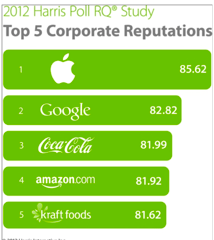
Apple took the top spot from Google for the highest corporate reputation score, according to the 2012 Harris Poll Reputation Quotient, a survey which measures corporate reputation for brands and companies in the U.S. The poll asks the general public to measure the reputations of the 60 most visible companies in the country. As reported last year, Google was top of the list in 2011′s rankings, followed by Apple and Amazon.
Harris says that Apple took the highest RQ score (85.62 this year, the highest RQ score ever achieved by any company in the 13 years of the RQ study) to secure the top spot in the ranking, with Google and the Coca-Cola Company taking the second and third spots, respectively. Amazon also saw a jump in reputation score, moving up from eighth to fourth place with Kraft Foods ranking fifth.
Audits begin at Apple's Chinese supplier plants
Apple today said that auditors from a labor rights group have begun inspections at Chinese factories that manufacture its iPad and iPhone.
The audits were the first since Apple joined the Fair Labor Association (FLA) last month after acknowledging that aluminum dust was responsible for explosions at two of its Chinese suppliers last year that resulted in four deaths and injuries to another 77 workers.
Apple was the first technology company to join the FLA as a participating member, the organization said in mid-January.
The FLA investigations began Monday at Foxconn facilities in Shenzhen, China, a major center of electronics assembly in the southern part of the country that abuts Hong Kong.
FBI seeks social media monitoring tool
In a move that's unlikely to sit well with privacy advocates, the FBI has begun scouting for a tool that will allow it to gather and mine data from social networks like Facebook, Twitter and blogs.
The goal is to use the tool to keep on top of breaking events, incidents and emerging threats, the agency said in a recent Request for Information (RFI) from IT vendors.
The FBI said it's seeking a "secure, lightweight web application portal using mashup technology."
According to the RFI document, "The application must have the ability to rapidly assemble critical open source information and intelligence that will allow [the FBI's Strategic Information and Operations Center] to quickly vet, identity and geo-locate" potential threats to the U.S.
Sunday, February 12, 2012
IPO Be Damned, Facebook Will Still Prioritize User Experience
For those not from Silicon Valley or Wall Street, there’s only 1 thing you really need know about Facebook’s plan to become a publicly traded company: Your Facebook won’t be suddenly overrun with ads. Facebook bluntly warns greedy investors “Our culture emphasizes rapid innovation and prioritizes user engagement over short-term financial results”, and CEO Mark Zuckerberg proclaims, “Simply put: we don’t build services to make money; we make money to build better services.”
Apple files another US patent suit against Samsung
Apple has filed another U.S. patent lawsuit against Samsung Electronics and is seeking a preliminary injunction asking a federal judge to halt sales of the Samsung Galaxy Nexus smartphone while the case makes its way through the court.
The lawsuit was filed Thursday in U.S. District Court for the Northern District of California, with a redacted copy of the case made publicly available Friday night. The lawsuit involves four Apple patents for technology that allows users to touch a phone number on a Web page to dial the number, word placement, Siri voice recognition and unified search, and the ability to unlock a smartphone by sliding an image from one location to another.
Should Mark Zuckerberg Think Twice About Establishing A Dynasty?
Congratulations Facebook! You have made history and changed the world. So, here are some thoughts from one of your biggest fans. Like the rest of the planet, I love Facebook and use it every day. So, there may never be a better time than now, when things are going really well, to add a dose of humility and perspective to the Facebook conversation.
Remember the movie Gladiator? Commodus, the bad son, murdered his aging father, Emperor Marcus Aurelius, preventing him from passing the empire down to his adopted good son, Maximus. Thus, instead of carrying on a centuries old tradition of merit-based succession, power passed to an unworthy blood relative and corruption followed.
Friday, February 10, 2012
FAQ: Windows on ARM explained
In an 8,600-word epistle yesterday, Microsoft's top Windows executive pulled aside the curtain on the first version of the company's iconic OS that targets tablets.
Dubbed "Windows on ARM," or WOA for short, the new edition is a cousin, perhaps one or two or even three times removed, of the still-under-construction Windows 8 for traditional PCs.
Steven Sinofsky, the president of Microsoft's Windows and Windows Live division, went into great detail on the underpinnings of WOA, and along the way answered some of the questions that have been burning a hole in analysts' and users' brains for more than a year.
Iran blocks access to some outside websites, services
The Iranian government has severed some citizens' connections to secure websites and services, including Twitter and Google's Gmail, according to reports by Iranians and network experts.
Starting yesterday, people who said they live in Iran began describing problems reaching websites secured with SSL (secure socket layer), which is used to encrypt traffic between computers and websites. SSL-secured sites begin their URLs with "https" rather than "http."
The Washington Post first reported on the new crackdown Thursday, and on Hacker News, one user chimed in with specifics.
For And Against The iPad Mini
Rumors of a 7- to 7.85-inch iPad have been swirling around for a long while now. We’ve seen reports get killed moments after they initially break, only to be sneakily resurrected weeks or months later. The rumor simply won’t die.
The problem, however, is that this one in particular is a tough nut to crack. When you take all the evidence both for and against a little iPad, you’re still left with no real conclusion.
So conclusion aside, here are some of the reasons Apple may, or may not, introduce the little iPad:
Tuesday, February 7, 2012
Amazon Incarnate: Bezos The Book Giant Is Planning A Store In Seattle

According to GoodEReader, Amazon is planning to open a retail store in Seattle this year where they will sell Amazon-exclusive books and, more importantly, Kindles of all kinds. While this looks to be more of a pop-up retail presence than a fully-fledged store, if I were in publishing I’d be circling the wagons right now.
To be fair, Amazon’s own publishing offerings are pretty wonky so far. There haven’t been many runaway successes coming out of the house although Seth Godin and Tim Ferris will soon be bringing their own brand of publishing success and there are some interesting cross-cultural titles coming out. But that’s not why publishing has to worry.
Lip Reading, 3D Desktops, And NUI: Microsoft Plans To Reinvent User Interaction
Deep in the skunk works of its Research and Labs divisions, secreted around the Seattle area, Microsoft is working on totally reinventing the way people interact with their computers. Very little is out in the open or in more than a prototype form, but the work is unquestionably being done.
Last week it transpired that Microsoft is working on building Kinect into the bezels of laptops, and after that, presumably, tablets and eventually mobile phones. But it’s not just about building out the install base for Dance Central 3. It’s enabling the next generation of awareness in our electronics. The iPhone ushered in an era where our devices know when we touch them. Microsoft is working on the next one, in which our devices will simply know us.
How do you, as a person, experience the world around you? You mostly see and hear, and to a lesser extent you touch, taste, smell. Our devices, however, are largely restricted to an extremely limited sense of touch. Why shouldn’t they be more like us?
Anonymous claims to have released source code of Symantec's pcAnywhere
Hacker group Anonymous claimed late Monday that the source code of Symantec's pcAnywhere had been uploaded on The Pirate Bay site.
Symantec could not immediately comment on whether the hackers had indeed released the source code of its product. "It happened so recently that we're still in the process of analyzing and won't be able to confirm until the morning," a spokesman said via email.
Earlier on Monday, an email string posted on Pastebin referred to negotiations over payment for the source code between one Sam Thomas, purported to be a Symantec employee, but using a Gmail mail id, and a person named Yamatough.
Monday, February 6, 2012
Wi-Fi in flight has yet to soar
Launched four years ago, the use of Wi-Fi on U.S. commercial aircraft has yet to catch on, with estimates that the wireless technology is still used by only 7% of the flying public.
There are a number of reasons: With Wi-Fi cropping up for free in many airports and public locations, passengers don't want to fork over as much as $10 for a flight of a few hours. Passengers also may not know when Wi-Fi is available on a flight since the airlines provide the wireless service on only a small percentage of their planes.
"The 7% [of in-flight Wi-Fi users] isn't too bad," said Amy Cravens, an analyst at In-Stat, since 7% in 2011 is an increase from 4% in 2010. "However, the service isn't profitable at these levels, so everyone is hoping it improves."
According to In-Stat, the nation's airlines collected $155 million in charges for onboard Internet service in 2011, and are expected to collect $225 million in 2012.
EMC launches 'Project Lightning' PCIe cards
EMC on Monday will launch its long-awaited "Project Lightning," now called the VFCache product line, an initiative to sell PCIe-based NAND flash cards for servers as a caching element to increase I/O performance by up to 4,000 times.
The company also will announce "Project Thunder," which in the second quarter will have EMC selling appliances filled with 15TB or more of PCIe-based NAND flash storage. The appliances will be connected to server farms through the InfiniBand network protocol. The appliances will hold five, 10 or 15 PCIe cards, according to EMC.
"You can think of it as a big, sharable, scalable VFCache card," said Mark Sorenson, senior vice president of EMC's Flash Business Unit. "We're talking hundreds of millions of [I/Os per second]."
VFCache cards are based on high-end, single-level cell (SLC) NAND flash as opposed to more popular multi-level cell (MLC) flash, which has higher capacity points but natively lower performance and endurance.
Saturday, February 4, 2012
U.S. Government & Military To Get Secret-Worthy Android Phones
The amount of stuff we trust to fly in and out of our smartphones is astounding. Just look at what happened when a couple of reporters got access to an unwitting (and rather unlucky) Apple employee’s iMessages alone — within days, they learned more about him than most people know about their closest friends.
Now, imagine all the stuff that could fly in and out of a government official’s phone, or that of a highly-ranked member of the military. Forget saucy texts and booty pictures — we’re talking about state secrets, here.
Looking to keep their secrets underwraps while on the go, the U.S government is working on a build of Android custom-tailored to meet their security requirements.
Word of the project comes from CNN, who notes that U.S. officials/soldiers aren’t currently allowed to send any classified data over their smartphones. If they need to transmit anything that might sink ships (so to speak), they currently need to find a secured (generally meaning hardwired) line hooked to an approved device.
Facebook malware scam takes hold
A "worrying number" of Facebook users are sharing a link to a malware-laden fake CNN news page reporting the U.S. has attacked Iran and Saudi Arabia, security firm Sophos said Friday.
If users who follow the link then click to play what purports to be video coverage of the attack, they are prompted to update their Adobe Flash player with a pop-up window that looks very much like the real thing. Those who accept the prompt unwittingly install malware on their computers.
Within three hours of the scam's appearance, more than 60,000 users had followed a link to the spoofed CNN page, according to Sophos Senior Security Advisor Chester Wisniewski. Facebook removed that link, but others are still being shared.
Friday, February 3, 2012
Google reveals Android malware 'Bouncer',scanns all apps
Google yesterday unveiled an automated system that scans Android apps for potential malware or unauthorized behavior, a move critics have long called the company to make.
The scanning service, appropriately codenamed "Bouncer," has been in action "a number of months," said Hiroshi Lockheimer, the vice president of engineering for Android, in an interview Thursday. "The interesting thing is that no one really noticed. It didn't disrupt the end user's experience [in the Android Market] or disrupt the developers. They didn't have to think about it at all."
Once an app is uploaded to Google by its developer but before it's published to the Android Market, Bouncer scans the code for known malware, including spyware and Trojan horses, and looks for behaviors that match apps which the company has previously decided are unacceptable.
Subscribe to:
Posts (Atom)
